
When AI Answers Are Too Generic: Define a Role in Four Steps
Contents
Why can someone else turn to AI for a report or presentation while yours comes back covered in critical comments? How you ask can make a difference. One option is to define a role: give the AI a perspective and a subject to focus on, so it has more direction than “write something for anyone.”
The Same Question, with More Direction
Take a weight-loss meal plan as an example. “Help me create a weight-loss meal plan” leaves a lot unspecified. An answer may look like a plan yet offer too little detail to act on.
You could first ask the AI to take a nutrition-focused perspective, giving the imagined persona a nutrition PhD, registered-dietitian credentials, membership in a nutrition association and a research interest in diet and weight loss. Then ask the meal-plan question. Those invented details describe the requested role; they don't give the model real qualifications or establish that its advice is correct.
The useful difference to look for is specificity. Without personal information, an answer would still be general, but it could explain meal frequency, food quantities and the purpose of each item. For an illustration of answer format, compare “a bowl of oatmeal” with “two eggs, 40 g of oats and 200 ml of low-fat milk or soy milk,” followed by an explanation. The quantities show what a more detailed answer looks like; they aren't a diet recommendation here. More detail can make an answer easier to assess without making it nutritionally right for a particular person.
How to Define the Role: Four Steps
The relevant perspective isn't always obvious. A meal-plan question suggests nutrition, but what about asking AI to analyze a cosmetics ingredient list? Which role fits that task?
Step 1: Match the role to the question. If you're unsure, ask: “I want to understand and analyze cosmetic ingredients. What kind of professional would I consult?” A list might offer six possible roles, with “cosmetic chemist” among them. Choose the role that matches what you want to understand; the exact list and order can vary.
Step 2: Build the background. A role can include more direction than “act as a cosmetic chemist.” Try: “Invent a cosmetic chemist persona with an educational background, professional qualifications, career experience and research interests.” Then keep the details relevant to your question. A focus on explaining formulations to non-specialists, for example, tells the AI what to emphasize and how to explain it. An impressive degree by itself gives the task little direction. The persona remains fictional.
Step 3: Put it into a consistent structure. Select the relevant details and write one prompt. Start with the role line—“Take the perspective of a cosmetic chemist”—then add four background sections: education, qualifications, career experience and research interests. Use those sections to specify the kind of work you want. For a hypothetical ingredient-list question, add: “Explain each ingredient's usual purpose in plain English. Separate what the label tells us from what would require more information about the formulation.” Now the role has a job to guide, and you have a form of answer you can assess.
Step 4: Ask the actual question. With that direction in place, ask what you wanted to know about the ingredients. The role and context can help focus the explanation; they don't guarantee a professional or factually correct answer.
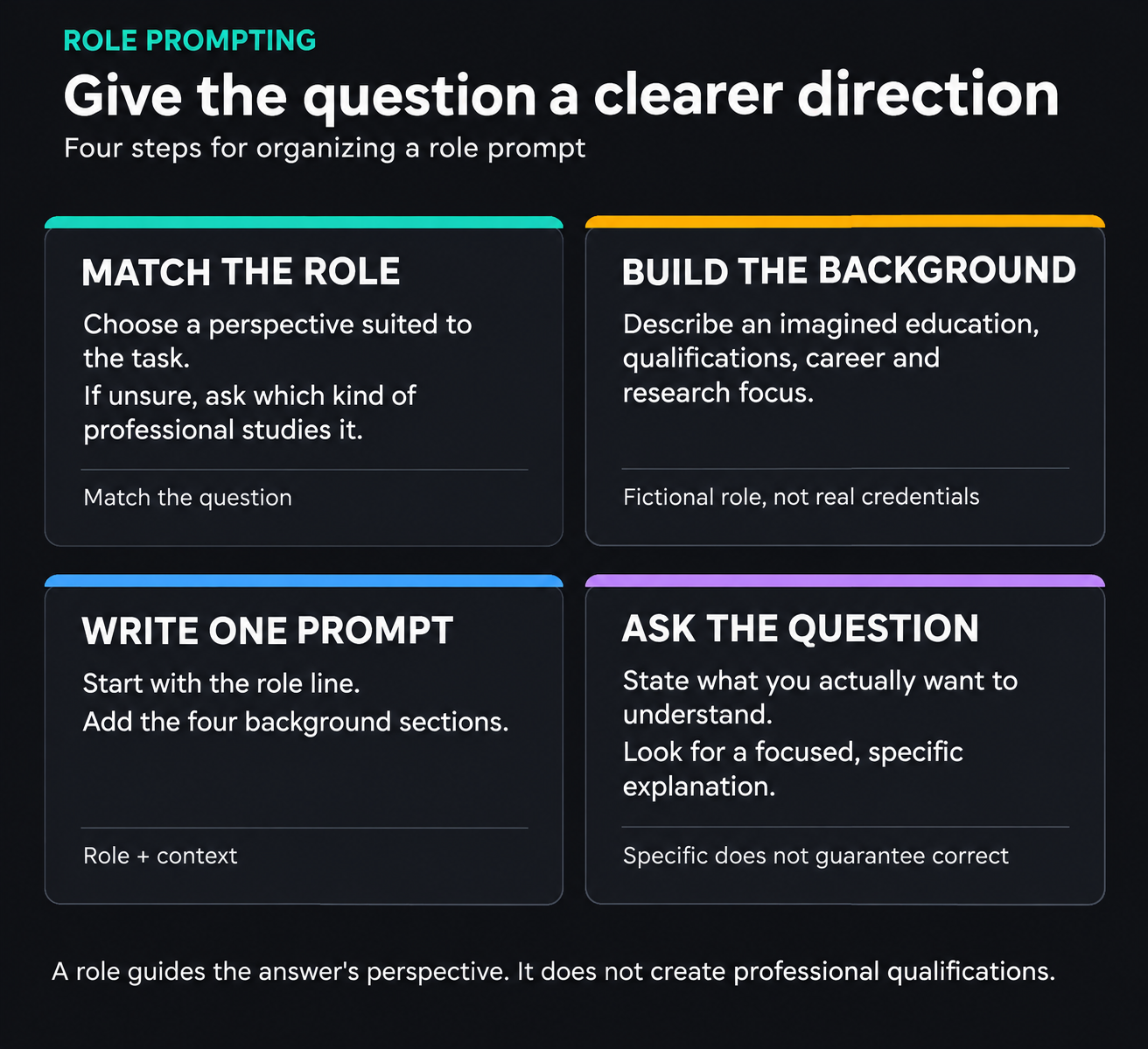
A role prompt organizes perspective and context before the question. It may make the explanation more specific, but invented qualifications do not make the AI a licensed professional or guarantee accuracy.
View full-size illustration
Role prompting is one way to give an AI answer more direction. There are other questioning methods, but this is a place to start. You can try the structure with different chat tools; how useful it is will depend on the model, the task and the information you provide.