
Codex Prompting in Four Layers: Principles, Rules, Patterns and Templates
Contents
Working with Codex involves more than picking tools and plugins. You also need a way to explain what you want it to build.
Your instructions matter to the result, and programming experience can help you write them. But you don't have to be a veteran developer to give the work a useful structure. This method organizes Codex prompting into four layers: principles, rules, patterns and templates. Copying a paragraph won't transform a project on its own.
Principles: Three Things You Can't Skip
Turning a requirement into something deliverable brings familiar problems, whether a person or an AI writes the code. Start with three concerns.
1. Boundaries: decide what to give up. When you direct the AI, you're paying for the tokens and making the tradeoffs. Before work begins, establish the goal, what can be sacrificed and what must be preserved. Tell Codex those boundaries. Leaving it to guess can waste both time and tokens.
2. Trade information for precision. A demo may turn a sentence or two into a working project. It can even look complete. But a project built from very little direction may have little of your perspective in it. A working demo and the thing you need aren't necessarily the same.
If all you can describe is a toy, a toy may be what you get—perhaps a polished one. Keep aligning the goal, background, constraints and details. That work can be long and tiring, much like a vendor and client agreeing on what a project should accomplish. It deserves time of its own; clearer agreement can save rework later. There are ways to make the exchange less laborious.
3. Documentation and verification. Both matter once a project has to be maintained or used in production. A conversation can contain agreements that become hard to recover after compaction or a handoff. Keep goals, decisions and progress in documents, updating them with Codex as the work changes. Those files give later sessions something durable to read.
Verify what the AI builds. Doing every check by hand is exhausting, so give Codex appropriate unit, automated and integration tests to run. Bring boundaries, information and verification into the conversation, and you'll have a firmer basis for judging the result.
Rules: Seven More Concrete Habits
The rules put those three concerns into practice.
1. Narrow the problem first. Before fixing a bug, adding a feature or starting a project, agree on the problem and its limits. Having an AI ready to type doesn't make an unclear requirement ready to implement.
2. State the time horizon. Codex needs to know whether you want a lasting solution, a transition or a quick way to stop the immediate damage. Spending more tokens and time may be acceptable for long-term work; an urgent fix may need a narrower answer. “Make this stable for the longer term” and “Change only this part; don't expand the work” are different assignments. Say which one you mean.
3. Use Plan mode. For a complex or uncertain task, let Codex investigate and propose an approach before implementation. Read the plan, correct what is wrong and revise it before moving ahead. Having it ask questions and offer choices can be easier than trying to supply every detail in one long message.
4. Structure the request. When a new chat involves work of some size or difficulty, organize the information so Codex can see how the pieces fit together.
5. Write the documents. Ask Codex to save the decisions and update them as the task progresses.
6. Verify. Ask Codex to run the relevant tests.
7. Recognize a fallback. After several failed attempts at a difficult bug, an agent may offer a workaround that makes the immediate symptom disappear while leaving maintenance or robustness costs. Look at what it trades away. For this workflow, require it to explain why the fallback is needed, its current risks and how it will be removed, then wait for your agreement before using it.
These habits are useful engineering practices with or without an AI at the keyboard.
Patterns: Turn the Rules into Prompts You Can Use
At the start of a chat, give Codex a structured account of the work. It can feel as though the AI sizes up the assignment by how you present it: a vague request leaves room for guesses, while an organized one gives it more to work with. Structure helps make both the assignment and its reply easier to assess.
Then emphasize what matters in the current situation. If the problem is unclear, diagnose it before changing code. If the approach is agreed and documented, proceed. Say whether the goal is a lasting improvement or an immediate patch.
The compatibility trap. Suppose you wrote a draft five minutes ago and now want to change it. Codex may propose preserving its old API and migrating gradually, as though that five-minute-old code already had production users. It can be funny to watch a throwaway draft acquire a legacy system's retirement plan. Explain that it hasn't shipped and say when a direct replacement is appropriate.
Repeated failure. Even a small text-alignment bug can lead to a string of increasingly narrow fixes. The agent may find a better route if you make it step back. Try: “Reconsider this: is the goal wrong, the approach wrong, or the execution wrong?” That asks it to examine the route instead of repeating the last move.
The “okay, keep going” trap. A task doesn't have to fail to outlive its usefulness. You may be making a small change in one corner of the product while the conversation becomes “okay, keep going” on repeat. The agent keeps finding work, as though another tiny improvement might earn it a better performance review. Ask whether the next change is worth its cost: “Is this a good stopping point?” Then: “Stop here and explain why.” Continuing needs a reason too.
Close the verification loop. For a reproducible bug, test-driven development gives you a concrete pattern: first write a test that fails on the bug, then fix it and run that test again. A pass shows that this reproduction now passes; it doesn't prove the whole product is correct. Feature work needs appropriate tests too, written before or alongside the implementation. For an open-source contribution, follow the project's own contribution and testing rules.
Document work that spans several rounds. Context changes, chats hand over and other people join. A written account of the goal, decisions and progress makes the next handoff easier.
Plan as complexity grows. A change involving a thousand lines is one example of work that may warrant a discussion of goals, constraints and scope first. The line count is a cue to think about complexity, not an official Codex threshold. Save the plan where it will help guide implementation.
A pattern for a substantial project. Discuss the goal → use Plan mode → write the documents → revisit the plan to find gaps → optionally ask another subagent to review the documents → implement. Return to planning when you reach a milestone or drift off course. The value of an extra review depends on the task; every document doesn't need the same level of scrutiny. Keep the plan, records and review connected to the work.
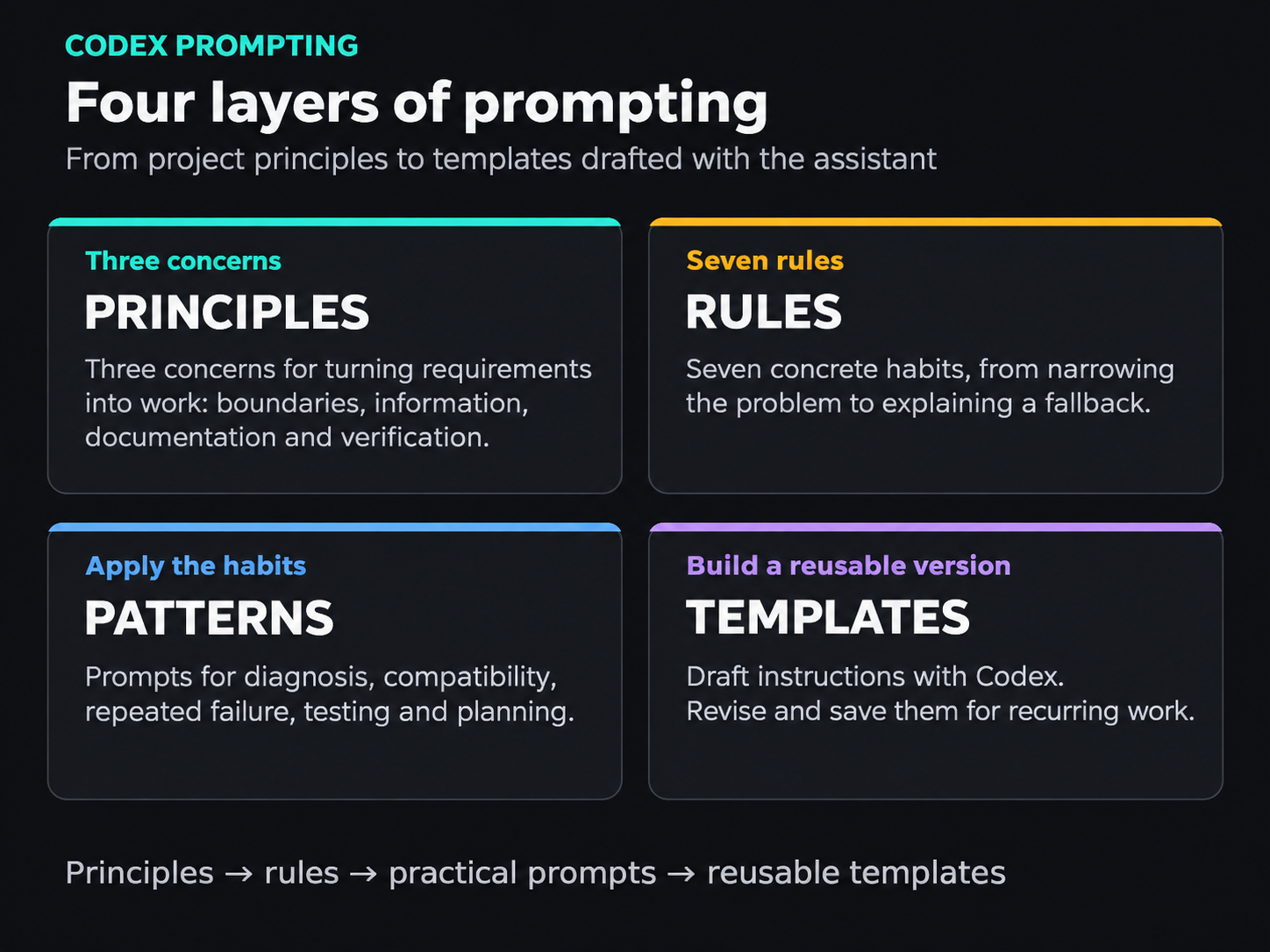
The four layers move from boundaries, information and verification to concrete rules, prompts and reusable drafts. They are a practical method, rather than official Codex requirements.
View full-size illustration
Templates: Draft the Reusable Version with Codex
The final layer is the most concrete. Turn a useful pattern into a template with Codex: choose a recurring situation and ask it to draft instructions you can read, revise and reuse. The short questions above can also be copied directly into a conversation. Save a version suited to the work you repeat.
A “temporary solution” template may overlap with the fallback rule. That's fine if it makes the decision clear: explain the immediate fix, the tradeoffs and the route back to a lasting solution, then get agreement. Don't leave the agent to assume that a short-term patch is what you wanted.
The first three layers are practical heuristics for organizing the work; the last makes them reusable with the assistant. They give you a way to direct Codex, examine its choices and keep the project moving toward the result you need.