Voice Input Is More Than a Productivity Tool: Speech Enters the Room
Contents
Speaking to your computer can feel easy at home and awkward at the office. Volume is only part of the difference. At home, you may have room to work out what you mean before anyone else hears it.
Typing Stays on Screen. Speech Enters the Room.
A half-formed idea, a sentence you delete halfway through, a small frustration with the work: typing gives those thoughts a place to develop without announcing them aloud. Say them instead, and nearby people may hear you organize the idea, correct a word, or disagree with yourself. A change of input method can feel like opening your brain and setting it on the desk.
TechCrunch's WSJ summary contrasts Gusto cofounder Edward Kim's awkwardness about dictation with Wispr founder Tanay Kothari's expectation of acceptance.
We Learned to Fit the Tools
From typewriters to computer keyboards, QWERTY to shortcuts, people have invested effort in learning a physical interface. Typing lessons, muscle memory, and the desire to get faster all help us turn thoughts into the form the machine accepts.
Speech tools offer another route. Recording and transcription have long let speech leave a record; generative tools can also help turn a transcript into a draft you can inspect and revise. For someone who thinks comfortably aloud, that can remove a step between having an idea and getting it onto the page.
Sit to Make Something. Move to Think It Through.
That is one useful way to arrange work, rather than a rule about how everyone thinks. A keyboard or drawing surface benefits from a steady position. Looking for an idea can sometimes benefit from a change of pace: walking, gesturing, or talking a problem through. Plenty of good thinking also happens in a chair.
The habit has a longer history than voice software. At Down House, Charles Darwin created the Sandwalk as a thinking path and walked it daily, as English Heritage records. That gives us an example of someone making space for thought, without requiring every important idea to have arrived on a walk.
A computer can put both activities into the same posture. You sit down to enter information and stay there while trying to decide what the information should be. If pacing or speaking helps you with that second job, the keyboard can feel like an awkward place to begin.
AI can help with parts of the work that follow: organizing notes, preparing a draft, or assisting with code. It hasn't taken over every task of making something, leaving people only to think. But voice input can let you try a different arrangement—work out an idea aloud, then return to the screen to judge and refine the result.
The Office Can Feel Like a Stage
Shared offices bring people together for collaboration, and proximity can be useful. It also changes what others can observe. A screen can be glanced at; a spoken draft can be overheard. Typing isn't automatically private, but speech exposes a different part of the process: the words before you've decided to keep them. A directional microphone changes what gets recorded, not whether your voice reaches the person beside you.
That suggests choices about space. A private room, a place for calls, or lower desk density might make some spoken work easier. Working from home can offer that room when the home itself is quiet and private; it can also mean sharing space with family or roommates. The office starts to feel like a stage when you have to perform a coherent thought before you're ready. Giving people places to be unfinished matters alongside giving them places to collaborate. In a quiet zone, the considerate option may still be to type.
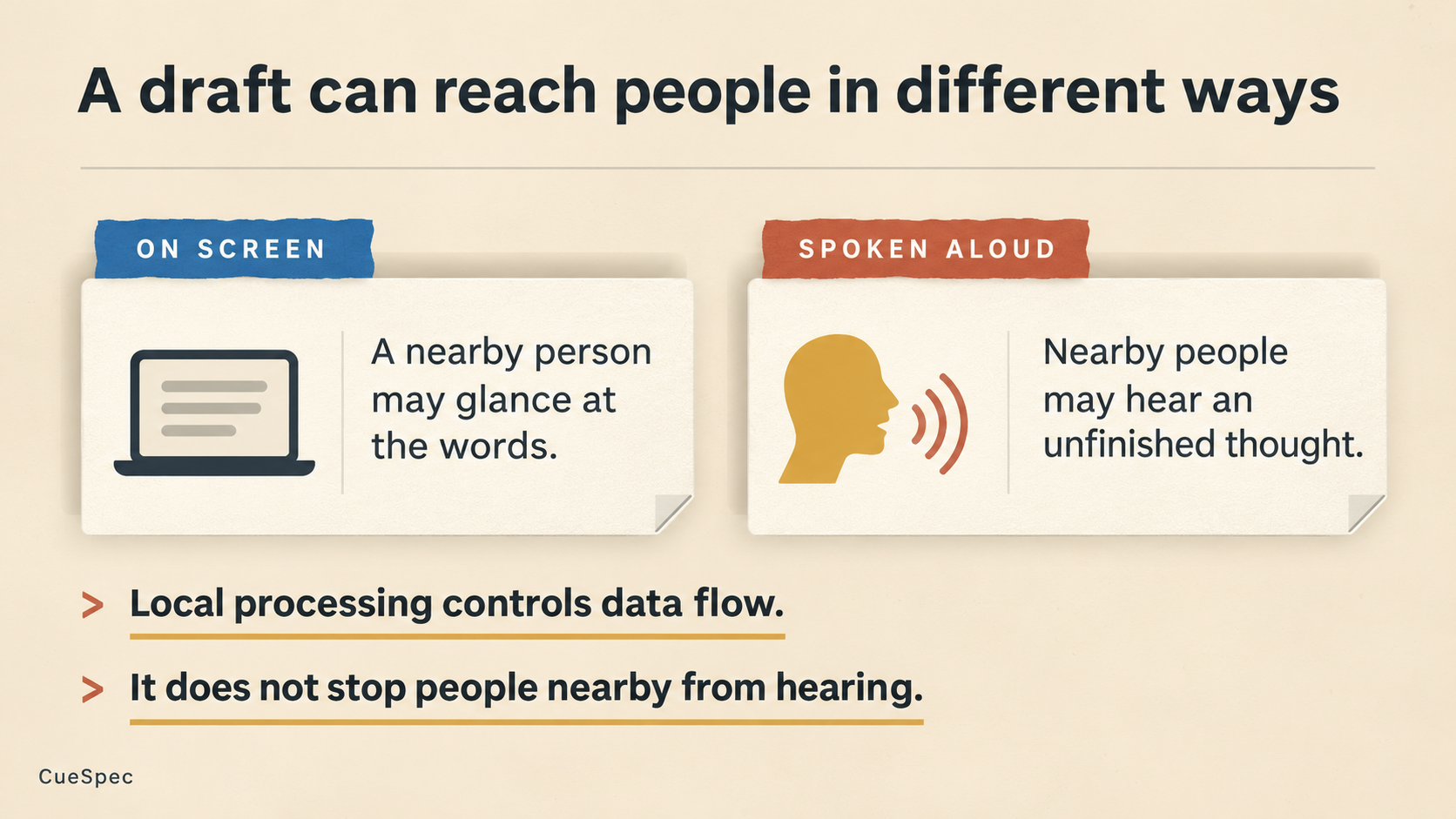
A screen can be glanced at and speech can be overheard. Local processing does not stop nearby people from hearing.
View full-size illustration
Revision Can Happen While the Thought Is Forming
Consider a spoken draft: “Send it Friday—no, Monday, after the review.” You can correct the thought as you say it, then ask a tool to organize the transcript. The draft still needs checking: did it keep Monday, retain the review condition, and identify what “it” refers to? Names, numbers, and negation deserve a look too. Revision can be part of developing the thought, with another check before the words go anywhere.
For people who reason aloud, that gives an unsettled idea somewhere to go. You don't have to compose every sentence at the keyboard before there is text to work with. Speech and typing can take different parts of the same drafting job.
Writing in another language adds a second task: deciding what you mean while finding the phrasing. Imagine thinking through an email in English that you need to send in Spanish. You could dictate the idea first, then use a suitable language tool to prepare a Spanish draft and review it. Transcription and translation are separate capabilities; the software and services you use determine the steps. The benefit to look for is room to settle the meaning before wrestling with the phrasing, with enough review to catch what translation changes.
Asimov Imagined a Much More Private World
Now take the idea further, as a thought experiment. A private workspace with room-scale voice capture might let you move around and speak without staying close to a microphone. Accurately separating speakers and capturing everything you intend would still be demanding design goals, rather than something to assume from the presence of a microphone. There is a reason to explore movement without turning it into a law of productivity: Marily Oppezzo and Daniel Schwartz's 2014 experiments found benefits for divergent creative thinking, such as generating possible uses for an object. They didn't establish a general improvement in focused thinking, decisions, or all work.
Extend the thought experiment to communication. Suppose each colleague had a private room and a convincing holographic presence in yours. You could turn toward them while they moved around their own space. That might preserve some of the freedom of working alone while offering a different kind of remote meeting. Whether it would feel more natural than a call is a question for the experience, not a result already established.
There is a familiar science-fiction echo: Isaac Asimov's The Naked Sun. On Solaria, people live in seclusion attended by robots; the publisher's description includes a character so reclusive that associates knew him through holographic projection. The setting puts technical sophistication and extreme distance between people in the same picture.
The novel first appeared in book form in 1957. Set private rooms, mediated contact, and abundant machine assistance beside that picture, and the resemblance is unsettling. It is a useful imaginative reference, not evidence that privacy demands must increase forever or that technology will inevitably carry us to Solaria.
There is no reason to treat that destination as the ideal. The same distance that protects an unfinished thought can make contact harder. Read as a warning, the setting asks what happens when a society gets very good at keeping people apart. The question is what we would choose to preserve while making work more private.
The awkwardness of office dictation, then, raises a design question about the office as well as the software: where can people think aloud without turning every draft into a performance?
P.S. The cold part of Solaria is how comfortable separation can become. Robots provide care; mediated contact removes the need to share a room. Privacy is easy to want. It is harder to decide when protection from interruption has become protection from other people.
A room to think in is a gift. A world you never need to leave is a more troubling proposition.