Why AI Writing Feels So Exhausting: Two Obvious Tells
Contents
I really can't stand AI-written articles anymore.
Open ten posts and it can feel as though seven or eight were churned out by AI, with nobody involved. Newsletter posts, social-media rants, opinion videos, content mills: the same voice everywhere.
I'm not campaigning against using AI. I'm not here to fight the future and tell everyone to stop.
What gets to me is the feeling of stepping on a land mine. You click something, read two paragraphs, and suddenly think: oh, this again. The prose leaves you feeling drained. Those familiar patterns can trigger the reaction even when they don't establish who wrote the text.
Imagine coming out of a movie and looking for a review that gives you another person's take. Here's an invented example of the pattern that wears me out:
The lead actress is outstanding. She isn't simply acting crazy; she conveys a deeply uncomfortable loss of control. When someone forces their love on you, that isn't happiness. It's disaster. This isn't a conventional stalker movie. It's a wish turning against the person who made it. It isn't a neat story of good rewarded and evil punished. It drags everyone into an ugly situation. It isn't telling some fresh story of unrequited love. It's telling the audience directly...
Five lines. Every one of them reaches for “not this, but that.”
I can't take this construction anymore. The sight of it makes me want to shut the laptop. Five lines in, and already I'm exhausted.
There's Nothing Wrong with the Construction Itself
“Not A, but B” isn't forbidden.
In ordinary conversation, it has a purpose: you anticipate an assumption the other person might make, then draw the distinction so they won't misunderstand you.
That's what the opening here is doing: “I'm not against using AI. I'm against using it this mindlessly.” The distinction matters because you could easily read this whole piece as an argument against AI, which isn't what I mean.
Now look at the construction in that review:
She isn't simply acting crazy; she conveys a deeply uncomfortable loss of control.
What does that mean?
There's barely a distinction. “Acting crazy” and “conveying a loss of control” are doing much the same work here. One phrase gets swapped for something grander and vaguer, then dressed up as a rebuttal.
It's like an empty ad line: I'm not drinking water. I'm drinking thirst quenched, pure satisfaction, the glorious relief of rain after a drought.
That's why this kind of writing is tiring. It's padding with no new information, firing at an imaginary target to squeeze in another “not this, but that.”
Nobody has established the supposedly mistaken view that “she's just acting crazy.” The sentence invents an assumption so it has something to argue against.
The next one is even clearer:
This isn't a conventional stalker movie. It's a wish turning against the person who made it.
Who said it was a conventional stalker movie? Who are you arguing with?
You can't tell whom the sentence is addressing.
The Second Tell: Baffling Metaphors
Some AI-style metaphors are so strange they're funny.
Take a fashion-video script. These next two lines are invented examples, too; the point is what the comparisons do.
It opens: “Have you seen that model walk? Her walk is as stiff as a parking fine.”
I'm lost already.
This is where the imitation of a person really starts to wobble: a metaphor arrives and the whole thing falls apart. Then comes another line: “She's got a great figure, but she walks the runway like a stiff drink.”
Who talks like that? Who makes that comparison?
It reads like word association. A walk, a fine and a drink can all be described as stiff. That doesn't mean they have the same quality.
For the walk, stiff suggests rigid movement. A stiff fine is severe; a stiff drink is strong. Neither the severity of a penalty nor the strength of a drink gives you a picture of how someone's legs are moving.
The comparison blurs those meanings together. The shared word takes the place of a shared quality. The sentence sounds as if it has found an image, but you still can't see the walk.
What would make sense? Stiff movement could suggest a robot. An awkward walk could suggest a child just learning to walk. An ungainly stance could suggest someone out of step in a dance class.
That's a connection a person can follow.
And that's the second source of the discomfort: the metaphor has a verbal association, but no internal logic.
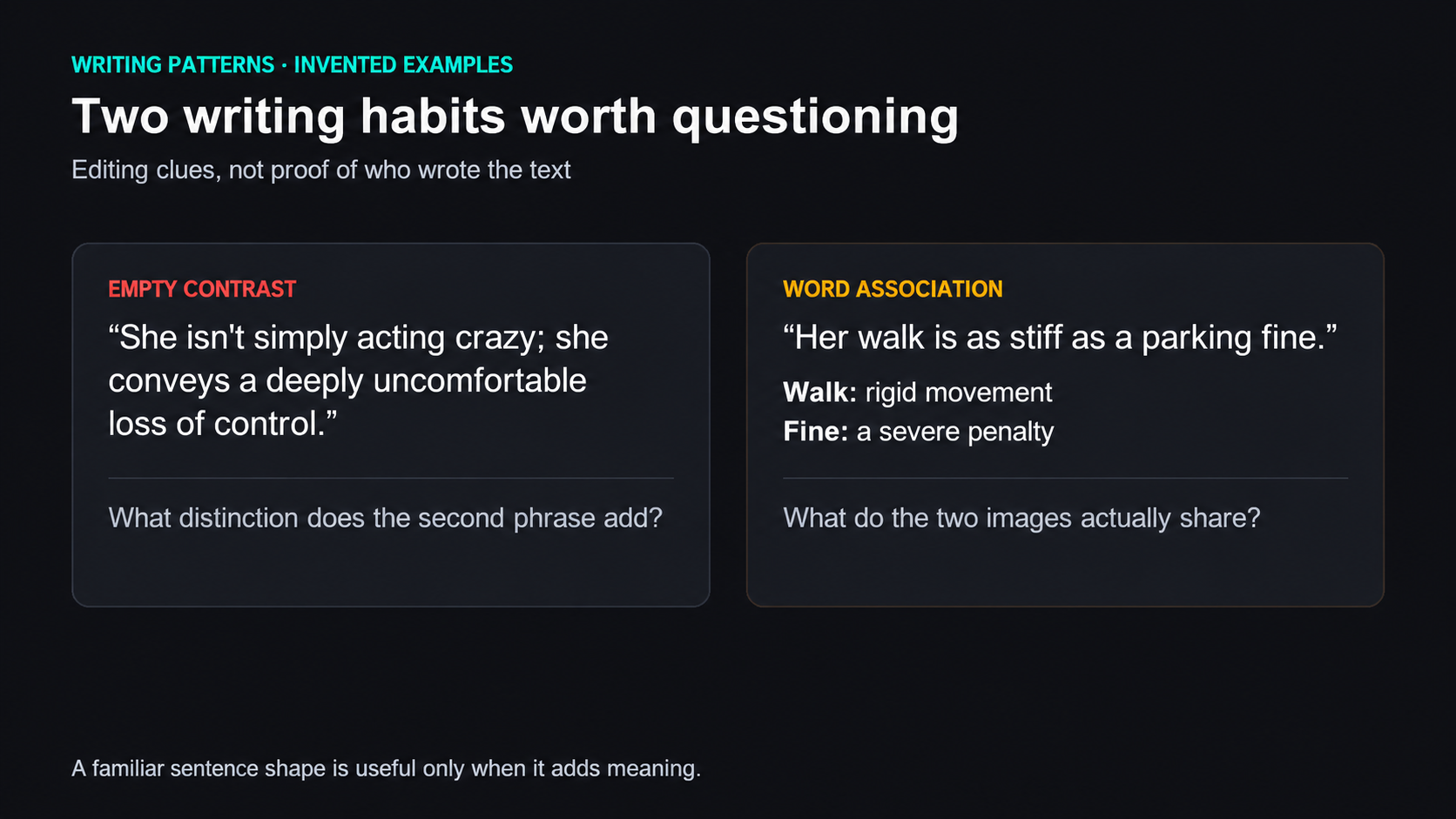
Invented examples for this essay: an empty contrast and a comparison built on a shared word rather than a shared quality. Neither pattern proves AI authorship.
View full-size illustration
What Makes a Metaphor Work?
A good metaphor brings two things to mind, then gives you the pleasure of noticing what they share.
A familiar metaphor is fine. An unremarkable metaphor is fine. A comparison that doesn't hold together at all is what I can't stomach.
Worse, a sentence like that can go out without anyone objecting. People may even praise it: that's a creative way to put it.
I'd rather read an ordinary sentence you wrote yourself than a broken comparison that pretends to be beautiful writing.
Why Bother Arguing About It?
Because what worries me is the effect on our feel for language, beyond any one article.
AI prose can imitate the rhythm of someone who writes well: where a metaphor should go, where a flourish belongs, where “not this, but that” will make an opinion sound incisive.
But the polished rhythm doesn't give me a sense of an experience behind the words. A sentence can make a deft little move and still say nothing. That's what bothers me about these metaphors.
My sense is that this is why reading them takes so much out of you. There are plenty of words and plenty of rhetorical moves, but little being said. Put a runway walk beside a parking fine and you can struggle to find the connection, even before you've stopped to work out exactly what's wrong.
For me, that's the exhaustion behind the “AI voice.”
Where I Draw the Line with AI
There is a place for AI in creative work: organizing ideas, suggesting possibilities, bringing up an angle I haven't considered. I'd even hand it the advertising copy I don't want to write.
But I don't want it writing the outline or first draft for me to edit. Too often, that voice feels baked in.
Maybe that makes me an old crank who's about to be left behind. I still find this kind of writing unusable.
If you think you express yourself badly and AI writes better than you, don't sell yourself short. Wanting to put your thoughts online is a good thing. Using AI doesn't make you morally defective, either.
But a creator with a large audience choosing to fob people off with this? I have a harder time respecting that.
One Last Thing
A film review can collect likes, a creator's videos can find an audience, without that response telling us who wrote the words or whether the comparisons work.
What worries me is something else: spending every day in this kind of language could wear away my own sense of how to say things.
I worry that our voices will gradually become alike: the same habits, the same mannerisms, the same almost interchangeable posts, until that synthetic style starts to feel normal.
Then you try to put your own thoughts in order and out comes “let's lay it all out, break it down, put it in the plainest possible terms.” At that point, who could tell the human-written piece from the AI-written one?
Where would that leave us?