
Starting with /grill-me: which of these five agent skills fits your next task?
Drafted and reviewed using AI assistance.
On this page
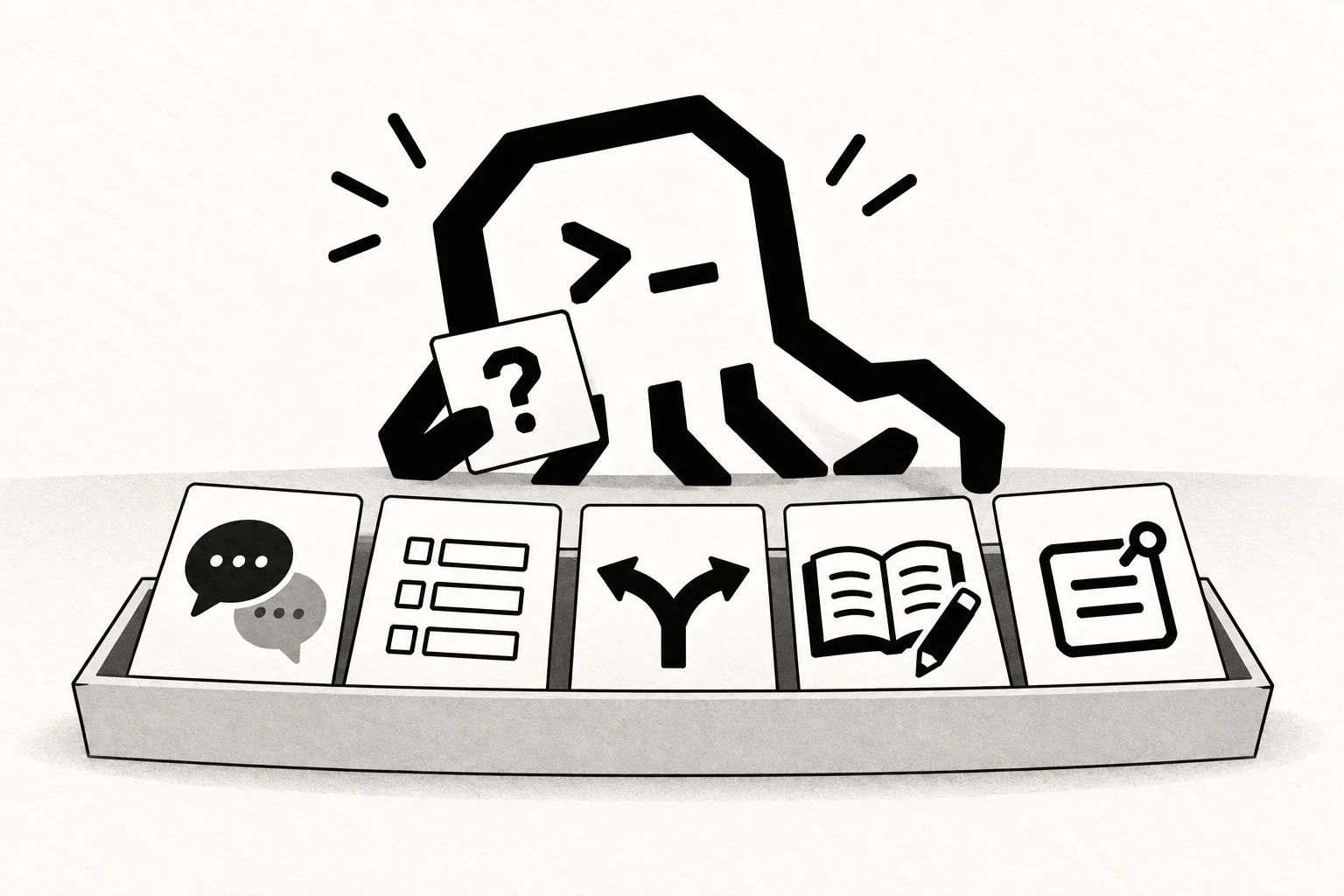
Start with the help your next task needs.
You have a proposal due tomorrow and ask AI to “help clarify my thinking.” Pause for a moment: have you not decided what you want, or is someone else holding information you need? Those require different kinds of help.
Choose an agent skill the same way: start with the task, then look for the capability. Popularity can introduce names. Where you're stuck and the result you need should guide the choice.
Here are five examples: Matt Pocock's grill-me, to-questionnaire, and teach; Jesse Vincent / obra's brainstorming; and Anthropic's skill-creator. They change how you work with an agent. The selection draws on skills.sh installation entries checked on 22 October 2026, arranged by use rather than global rank. Scenarios and requests illustrate their original descriptions, rather than hands-on tests.
Start with the problem you actually have
| Where you're stuck | Look at | What you're seeking |
|---|---|---|
| Your idea still contains unsettled decisions | grill-me → grilling | Rounds of questions that clarify decisions |
| Someone else knows what you need to find out | to-questionnaire | A questionnaire they can complete asynchronously |
| The goal is roughly clear; the approach isn't | brainstorming | Alternative approaches and an agreed design |
| You understand an explanation but can't do it yourself | teach | Focused lessons, practice, and learning records |
| You keep using a method and want to preserve it | skill-creator | A skill refined through examples and feedback |
These can serve separate jobs. Needing a questionnaire doesn't mean completing four other workflows first.
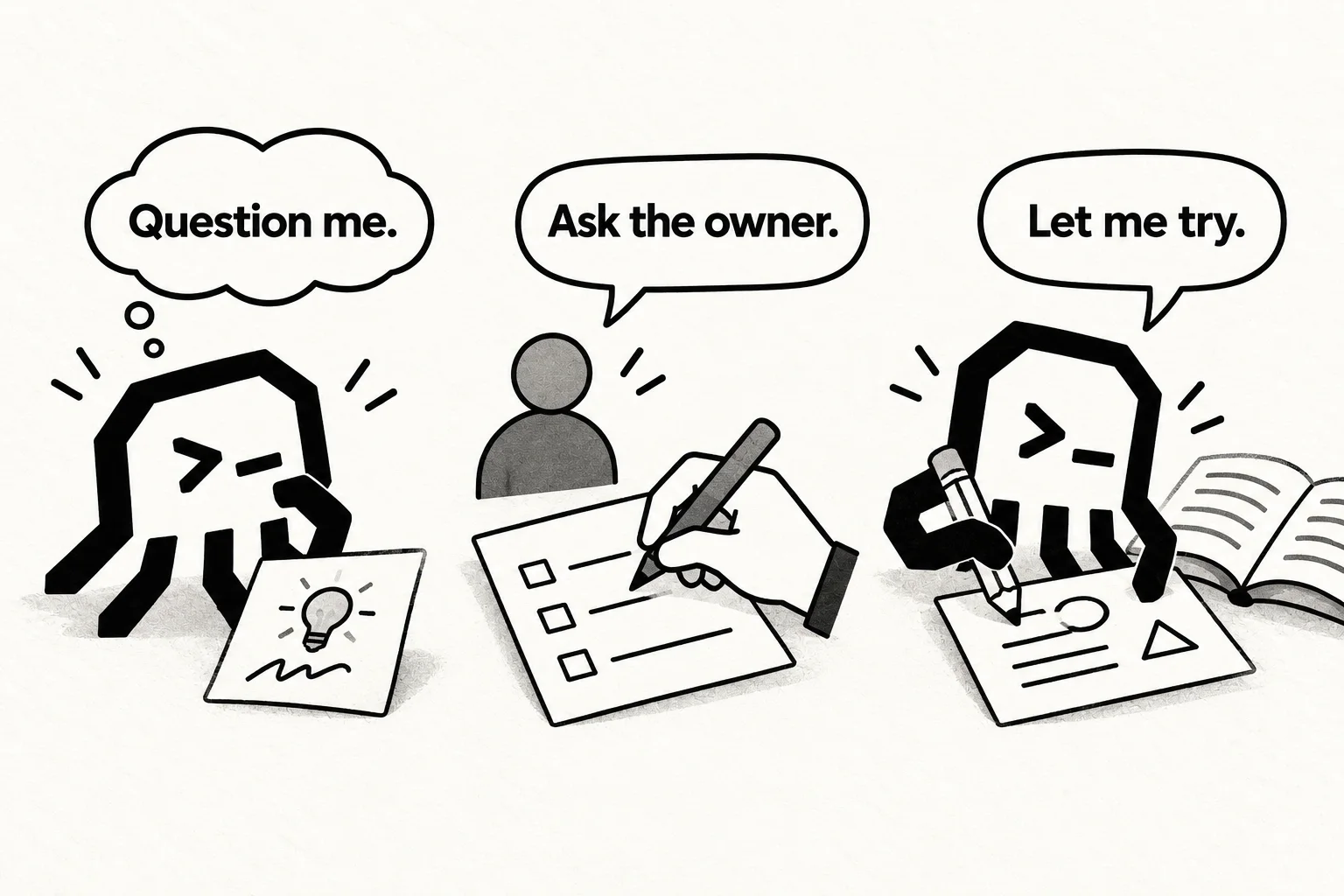
Question your decisions, ask the person who knows, or learn by trying—the need guides the choice.
grill-me: surface the decisions you haven't made
“I want to run an AI learning group” can sound like a plan before you've decided who it's for or what participants should be able to do afterward.
Matt Pocock's grill-me is an entry point calling grilling. Its interview rules identify decisions whose prerequisites are settled, then ask a round of questions with recommended answers. Dependent questions wait for later rounds. A round can contain several questions.
I want to run an AI learning group. Challenge me on the audience and intended outcome before discussing the format. Offer recommendations, but leave the decisions to me. Don't write promotional copy yet.
Use it to expose unclear choices. A missing fact you can look up doesn't need an interview. The host must also be able to call the companion grilling skill; the entry file alone isn't the full capability.
to-questionnaire: ask the person who holds the information
Suppose you're redesigning a shop's menu, but don't know which information is final or what must remain. Further questioning you won't uncover facts only the owner knows.
Matt Pocock's to-questionnaire establishes who will answer and what you need back, then writes a Markdown questionnaire for asynchronous completion or a meeting.
The shop owner will complete this. I need to know which menu information is confirmed, what cannot change, and who approves the final content. Help me organize those questions.
It turns “understand the requirements” into questions another person can answer. You still arrange delivery and wait for their knowledge. If the decisions are yours to make, the live questioning of grill-me is a closer fit.
brainstorming: compare ways forward before settling
You may know the goal and still accept the first approach an AI suggests. To help busy colleagues understand some research, should you produce a one-page brief, a short presentation, or searchable reference material? Each asks different things of readers and maintainers.
The obra / Superpowers brainstorming skill examines context, proposes two or three approaches with trade-offs, and works toward a chosen direction and approved design. Its scope includes plans outside software.
Compare a one-page brief, a short presentation, and searchable reference material for communicating this research. Focus on reading effort and ongoing maintenance. Help me choose a direction first.
This is more involved than generating ten ideas. Clear, tiny tasks have a quick path; substantial implementation involves design approval, follow-on planning, and supporting skills and tools.
teach: connect an explanation to your own attempt
You follow an AI's explanation of a chart, then freeze when shown another one. Matt Pocock's teach treats learning as work across sessions: establish a purpose, use resources for focused lessons and practice, give feedback, and retain learning records.
I want to judge whether a chart supports its author's conclusion. Start with axes and sample coverage. Let me explain a chart first, then point out what I missed.
The useful shift is from receiving an explanation to trying something yourself. Learning files provide a place to resume. This needs an environment that can read and write those files and present HTML lessons or exercises. For a quick definition, ordinary chat may suffice. The method's design isn't proof of improved retention.
skill-creator: refine a method you keep using
Perhaps you prepare a weekly research brief and have a recognizable method: which sources count, how to separate new developments from repetition, and what colleagues need to receive.
Anthropic's skill-creator helps express the requirements as a skill, then improve it through task examples, result evaluation, and feedback.
Help extract the inputs, usage conditions, and output requirements of my weekly research-brief method. Then design examples that check for omissions and duplicate coverage.
It fits a method you can explain and whose results you're willing to inspect. If the goal changes every time, work through concrete tasks before packaging it. Writing instructions and running the full evaluation workflow are different levels of work. This implementation targets Claude; confirm support for its evaluation tools in another agent.
Use popularity to discover, then choose by task
A GitHub repository can contain many skills. Its stars signal attention, rather than grading each item inside it. skills.sh installation counts come from anonymous Skills CLI installation telemetry; they aren't independent-user counts, active usage, or evidence of effectiveness.
Popularity can suggest something worth reading. Follow that lead to the original instructions and environment requirements. For example, grill-me and grilling have separate entries: adding their numbers doesn't produce a user count for one skill. Discovering five candidates doesn't mean installing all five.
Try ending your choice with a sentence: “I haven't resolved this idea and want AI to question me,” or “The owner knows the missing facts; I need questions they can fill in.” The first points toward grill-me, the second toward to-questionnaire. Choosing the help your next step needs gives you a more useful starting point than collecting skill names.
Sources and further reading
- Matt Pocock, grill-me entry point and grilling interview rules. Invocation and rounds organized by decision dependencies.
- Matt Pocock, to-questionnaire original instructions. Questions for another knowledgeable person.
- Jesse Vincent / obra, brainstorming original instructions. Context, alternative approaches, and design approval.
- Matt Pocock, teach original instructions. A persistent teaching workspace, lessons, and learning records.
- Anthropic, skill-creator original instructions. Creating, evaluating, and improving skills.
- skills.sh, Matt Pocock entries, brainstorming entry, skill-creator entry, and statistics FAQ. Entries checked on 22 October 2026 (UTC). Public counts informed discovery; these skills were not installed or tested for this article.