
AI Story Ideas Can Improve a Story While Making the Collection More Alike
Drafted and reviewed using AI assistance.
On this page
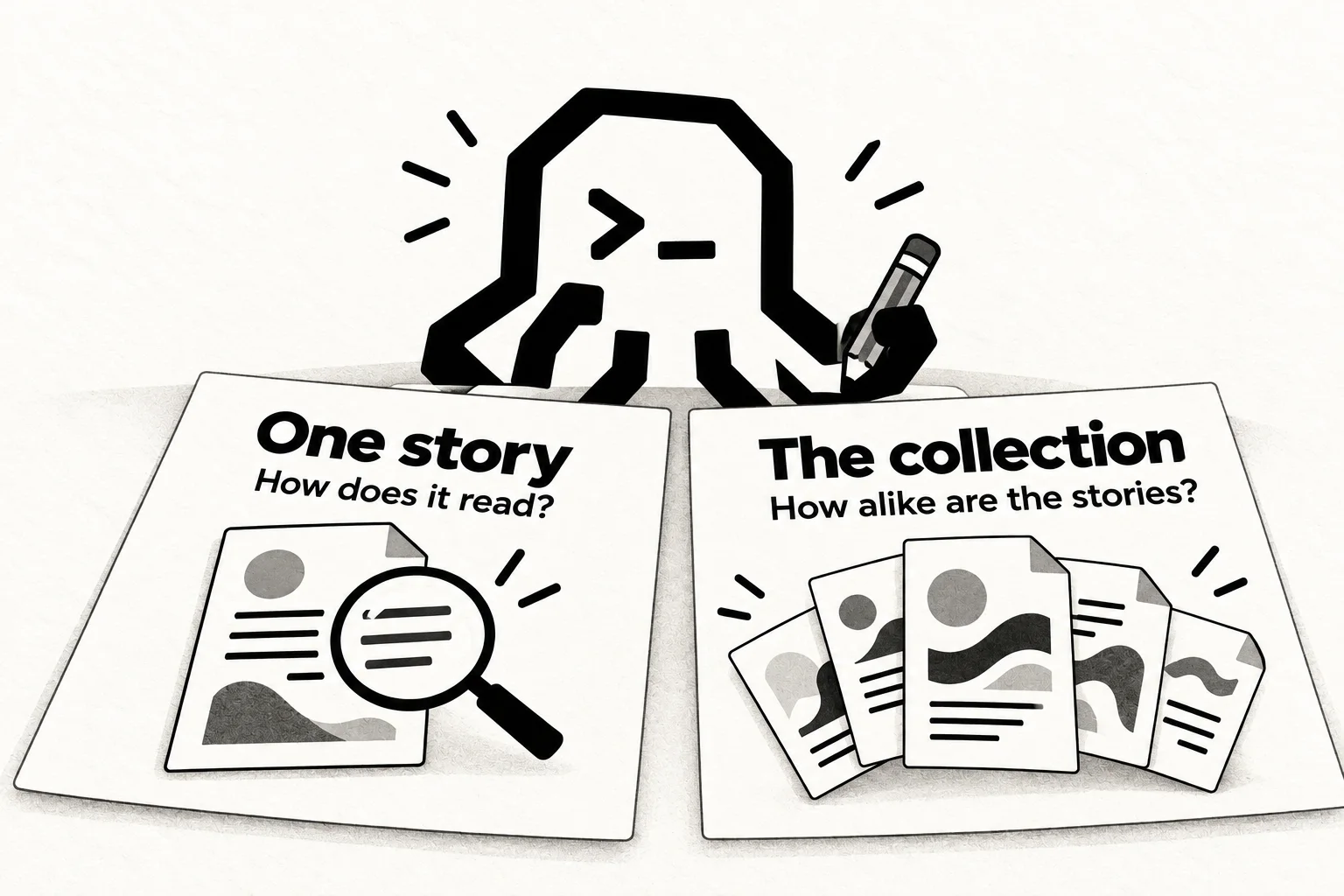
A story can earn better reviews while resembling the rest of its group.
You can like each piece in a batch and still feel that the batch keeps returning to the same place. That's worth considering when you use AI for ideas: how well one piece works and how much variety a collection offers are different questions. A higher score on the first doesn't settle the second.
A 2024 study by Anil R. Doshi and Oliver P. Hauser found both higher evaluations of individual stories and greater similarity among stories when writers had access to AI ideas. The two findings aren't contradictory. They use different measures.
How good did each story seem to readers?
The preregistered online experiment's final sample comprised 293 UK participants, not a professional-writer sample. They wrote eight-sentence English stories on one of three assigned adventure topics: the open seas, a jungle or another planet.
Writers were randomly assigned to no AI ideas, the option to request one GPT-4 idea, or the option to request up to five. Each AI idea was a three-sentence starting point. People wrote the finished stories; the experiment wasn't asking GPT-4 to write complete stories for them. “Up to five” describes the available option, not what every writer requested.
A separate group of 600 readers first rated the stories without being told about the writers' AI use. That initial evaluation stage matters: the ratings preceded the later disclosure used for other questions.
Readers assessed novelty and usefulness. Here, novelty included how original and rare a story seemed; usefulness concerned its suitability for the intended audience and potential for development into a publishable book. These were reader judgments, not actual publication results.
On average, the AI-access conditions received higher novelty and usefulness ratings than the no-AI condition, with larger gains in the up-to-five condition. That says something about how the individual stories were received. It doesn't yet tell us how different those stories were from one another.
How different was the collection?
For that question, the researchers used text embeddings—numerical representations of the stories. They calculated cosine similarity between each story's embedding and the average embedding of all the other stories in its experimental condition. Both AI-access conditions produced stories more similar to their own group's average than the no-AI condition did.
This is a measure of similarity in those text representations, not a word-for-word duplication rate or a measurement of all cultural diversity. A story can earn a favorable reader response while moving closer to the rest of its group on that separate measure.
| Question | What the study measured |
|---|---|
| Does this story seem novel and useful? | Readers' evaluations of the individual story. |
| How similar is this story to its group? | Its embedding's similarity to the average of the other stories in that condition. |
The authors discuss anchoring on AI ideas as an explanation. But the experiment didn't compare thinking alone first with consulting AI first, or isolate every cognitive mechanism behind the similarity. It studied constrained short fiction with the GPT-4 available then, not every kind of creative work or the models available in 2026.
Use the distinction when reading your existing ideas
One editorial application is to open a shortlist of topics you already have and read it as a collection. Look past the titles: are several candidates addressing the same problem from the same angle? Better wording can make each candidate appealing without adding another reason to keep it.
Choose one substantive difference you can explain. Perhaps a candidate addresses a different reader decision, or you have work observations or reading material that let you examine a different aspect of the problem. Keep it because that difference matters to the intended reader. If those observations or materials exist, bring them into the request rather than asking AI to invent a personal experience.
Then ask AI to help express the distinction you've chosen:
Help me describe why this topic belongs beside the others. Use the different question and supporting material I've supplied; don't turn it into another version of the same angle or add experiences I haven't provided.
The useful outcome is a reason for keeping that candidate, not a longer list of generated alternatives. This is an editorial suggestion, not an intervention tested by Doshi and Hauser, and it doesn't guarantee variety. Nor does their study establish that thinking first, changing roles or opening more chats preserves it.
Variety also needs a purpose. For a set of standard notices, consistency may be exactly what you want. For a set of articles meant to cover different questions, resemblance deserves a separate look from the quality of each draft.