Before You Call an AI Study Session Finished
Drafted and reviewed using AI assistance.
On this page
Try one problem with the chat closed, and notice where you get stuck.
You've reached the end of a problem with an AI assistant. The steps are laid out, the answer is there, and the explanation makes sense as you read it. Before moving on, there's another thing you may want to find out: how much of that work could you do without the conversation beside you?
If your aim is to learn, a completed exercise is only part of the picture. Doing better with help doesn't by itself establish what you can do independently. You can make room for that question without giving up useful assistance.
What happened when the help was removed
Hamsa Bastani and colleagues examined this issue in a study published in PNAS in 2025. In fall 2023, nearly a thousand students in grades 9–11 at one high school in Turkey reviewed previously taught mathematics. Classes were assigned to a no-AI control group or one of two GPT-4 tutoring tools.
Students could use course books and notes during practice; the two AI groups also had their assigned tutoring tool. GPT Base offered a chat interface resembling ordinary ChatGPT. GPT Tutor encouraged hints rather than full answers, but its design went further: teachers supplied correct solutions, common mistakes and guidance for feedback. It wasn't simply a chatbot given a one-sentence request to “only give hints.”
Both AI groups scored higher during practice. Then students took an exam with books and laptops closed, on problems conceptually very similar to those they'd practiced. The Base group's exam performance was about 17% lower relative to the control group's mean exam score. The Tutor group's result was not statistically distinguishable from the control group's; the study didn't establish an additional learning benefit on that unassisted outcome.
So the better practice results didn't carry over in the same way when students had to work alone. And the Tutor findings concern a tool built with teacher materials as well as instructional safeguards. They don't establish that adding a hint-only sentence to your own chat will reproduce its results.
This was a short-term mathematics evaluation at one school, using the GPT-4 available in 2023. It doesn't measure long-term retention, adult programming skills or every AI tool available in 2026. The useful question it brings to a study session is narrower: what can you do when the assistance isn't supplying the next move?
Leave yourself one small attempt without hints
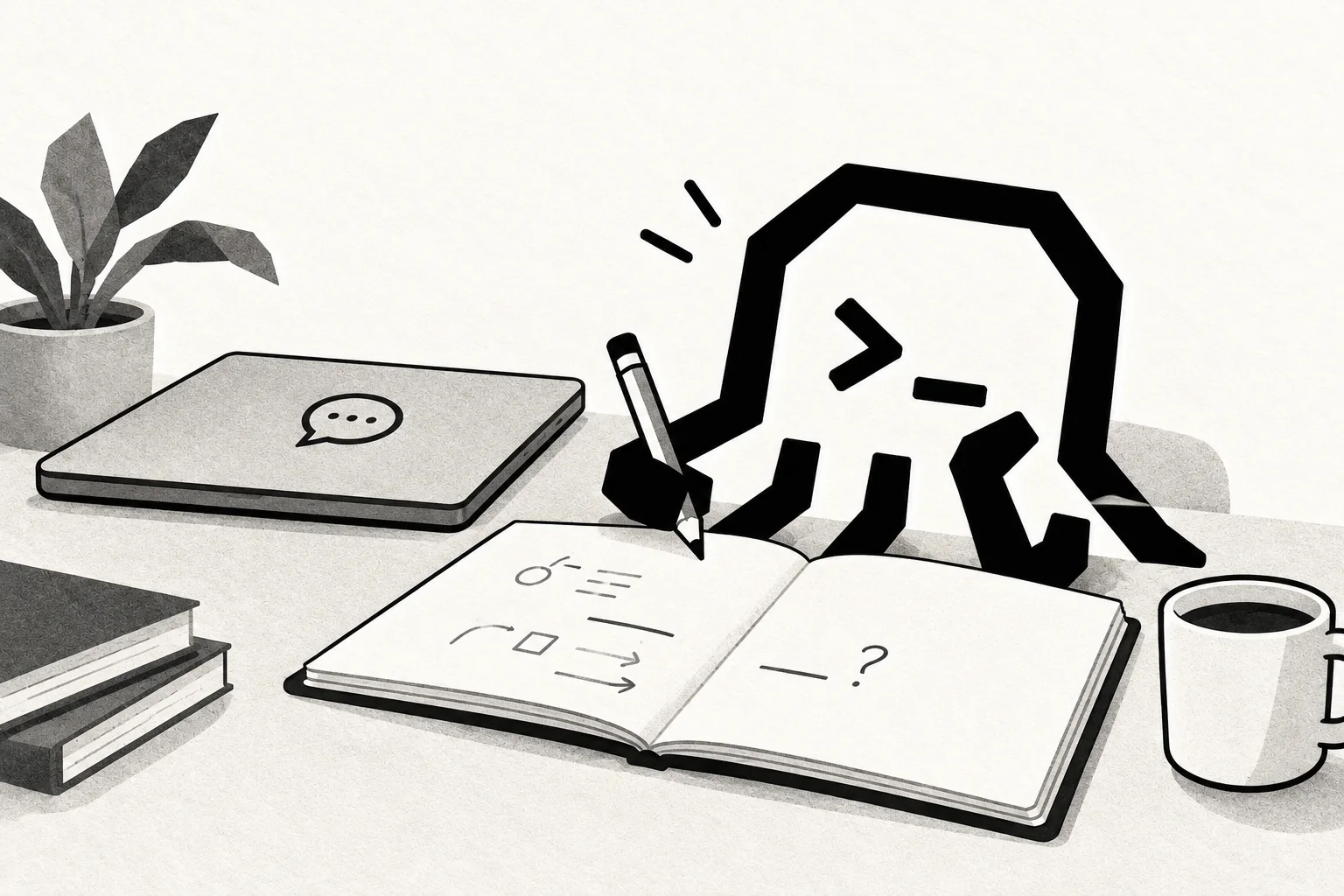
For adult self-study, here's an editorial suggestion to try at the end of a session. Choose an exercise you haven't done from the course or textbook you're already using, on the same concept and with a dependable worked answer available. Close the chat and the worked answer. Attempt the problem yourself, including why you chose the steps you took.
Then compare your work with that reliable answer. Look for the first point where you couldn't proceed or couldn't justify a step. That gives you something more specific to bring back to the assistant than a request to explain the whole topic again.
You could ask:
Here's the problem, my attempt and the step I can't justify. Using the reference solution I've supplied, give me a hint about that step so I can try to continue. Don't finish the solution for me.
The thing to notice is how far your own reasoning got before the hint. A complete answer produced together can hide that boundary; your attempt makes it available for the next discussion. Keep the problem and your reasoning with the feedback so you can return to the particular difficulty.
This closing exercise is our suggestion, not an adult learning intervention tested in the school study. One successful attempt also doesn't establish lasting mastery or the ability to apply the idea in a different setting.
If you want an example of putting a reason into words before asking for help, our photography-learning article works through an exposure choice. It illustrates how to discuss an explanation, rather than reporting a learning experiment.
Use the unassisted attempt when learning to do the work yourself is part of your goal. There is no need to turn every useful AI-assisted work task into an exam.