
Talking to AI About a Hobby You Don’t Have to Master
Drafted and reviewed using AI assistance.
On this page
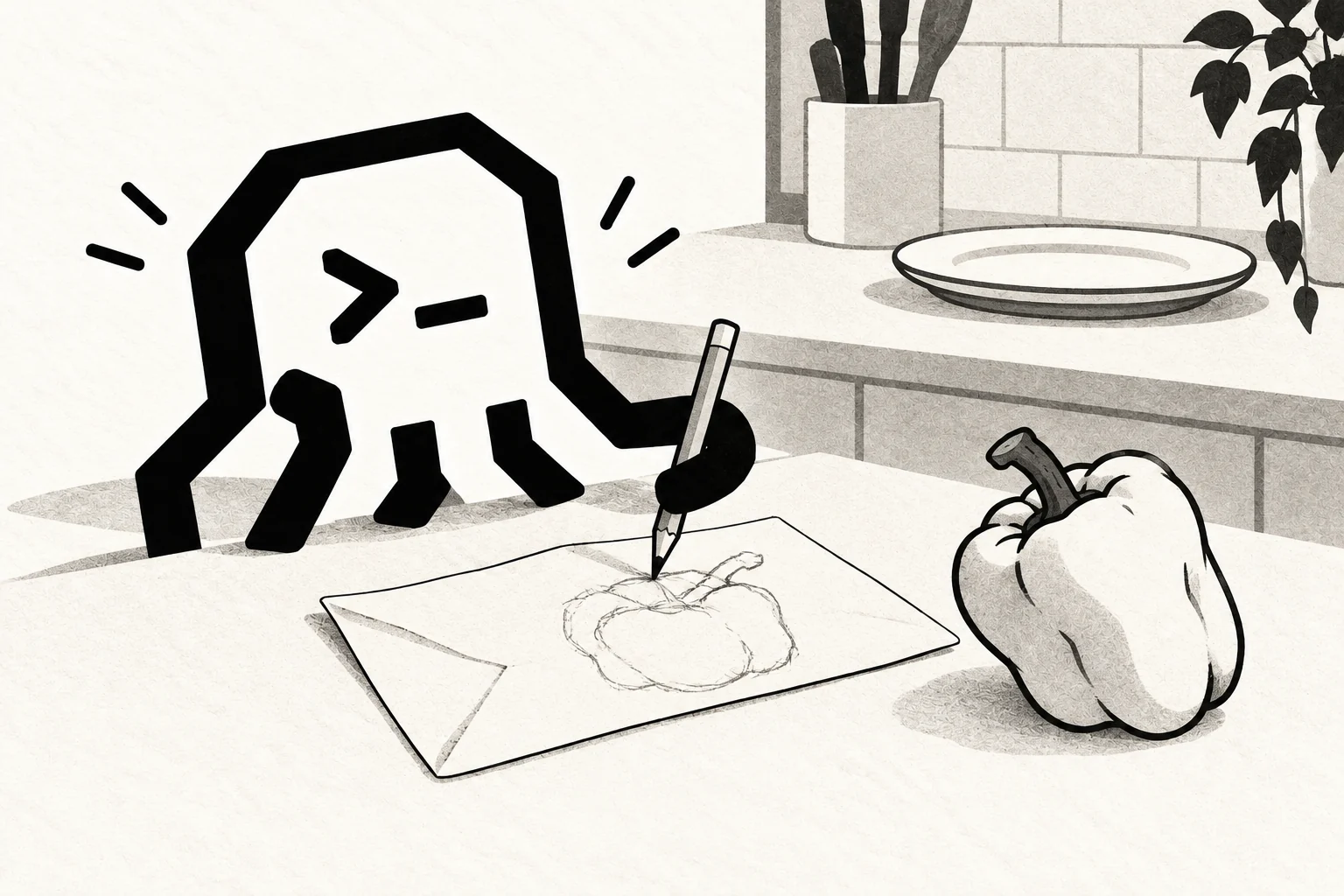
An imagined evening with a pepper, a pencil, and a little time to draw.
Imagine a Thursday evening after dinner. There’s a bell pepper on the kitchen counter, a pencil in a drawer, and an envelope you can draw on. You feel like making a picture. Nothing elaborate. You’re curious about whether a few lines could look like that pepper.
You ask an AI assistant how to start drawing. Suppose it offers a thirty-day course: basic shapes, shading, perspective, a practice schedule. It might be a useful answer for someone who wants to learn. But you were hoping to spend part of this evening drawing, and now you’re considering whether you can commit to a month.
Somewhere in that exchange, an activity acquired an ambition.
There are good reasons to want to draw well. Perhaps you’d like to make a birthday card that looks like its recipient, or finally understand why your sketches seem flat. A lesson could make that more interesting. There is also a different reason to draw: you like what happens while you’re doing it. The pencil catches on the paper. You notice that the pepper is lopsided. You give it an implausibly long stem and decide to keep it.
The distinction is about what you want from this particular occasion. It isn’t a division between serious artists and people who are “just having fun.” The same person might want careful feedback on Saturday and an aimless doodle on Thursday. Even the same drawing can provide both pleasure and a useful lesson.
That distinction has a research counterpart. In a 2021 paper, Gabriela Tonietto and colleagues examined leisure enjoyed for itself and leisure undertaken for another purpose. Two studies linked seeing leisure as wasteful with lower enjoyment, especially of activities done for their own sake. Two further studies manipulated messages about leisure’s value: messages calling it wasteful reduced immediate enjoyment. Messages presenting leisure as productive did not increase enjoyment.
Those findings concern particular study activities, not a rule for every hobby. But they give us reason to question a familiar defense of free time: that we can justify it by explaining what it will eventually produce.
A drawing might help you develop a skill. It might also never become more accomplished than the one on the envelope. If making it was absorbing, that is part of what happened tonight, even if there’s nothing you want to frame afterward.
Of course, an evening doesn’t become enjoyable merely because someone tells you to enjoy it. A blank page can be dull. Getting stuck can be irritating. Wanting a little help doesn’t necessarily mean wanting a curriculum.
This is where a smaller conversation with AI could fit. Instead of asking broadly how to take up drawing, you could explain the evening you have in mind: a pencil, scrap paper, something playful to try, no interest in planning future practice. Ask for one idea. Perhaps the suggestion is to turn the pepper’s bumps into a row of houses. You can borrow the idea, change it, or find it unappealing and draw something else.
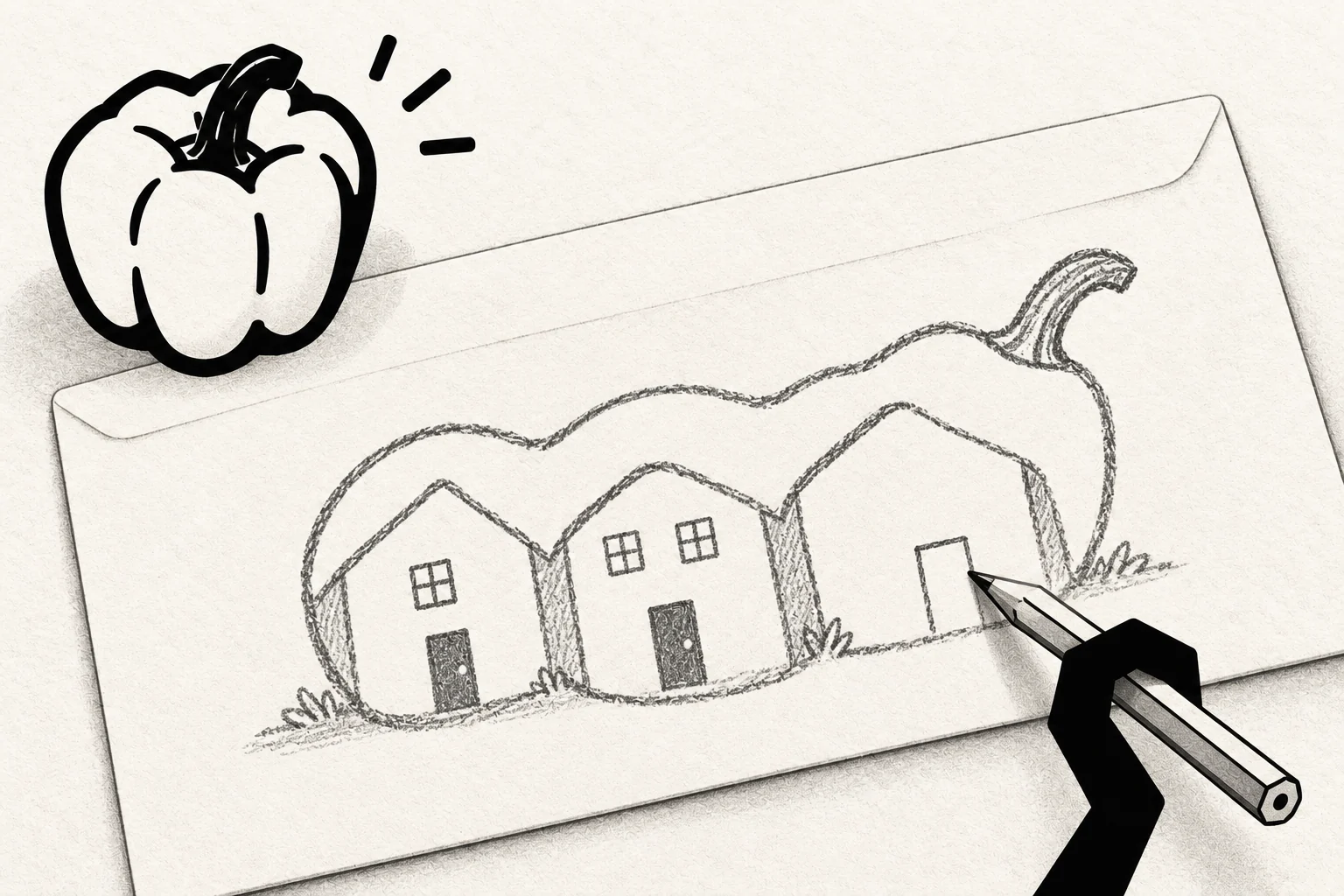
An imagined starting point: turn a pepper’s bumps into little houses.
That use of AI is an editorial suggestion, not something the leisure study tested. Its purpose here is modest: to offer a starting point when you want one. There’s no need to upload the result for a grade, unless feedback is part of what you would enjoy. Nor does a successful chat need to continue once you’re interested in the paper in front of you.
You may find yourself wanting to understand shading after all. A more accurate shadow could be a pleasure to discover. You can ask about that when the question becomes interesting; it doesn’t have to be the price of admission.
For now, the envelope has a pepper on it, and one of the houses needs a window. That is a perfectly good place to spend the rest of the evening.